headline

Training, racing, gear, facial hair styles and thoughts from my push to become an elite cyclist.
Showing posts with label manifesto. Show all posts

Wednesday, August 24, 2011

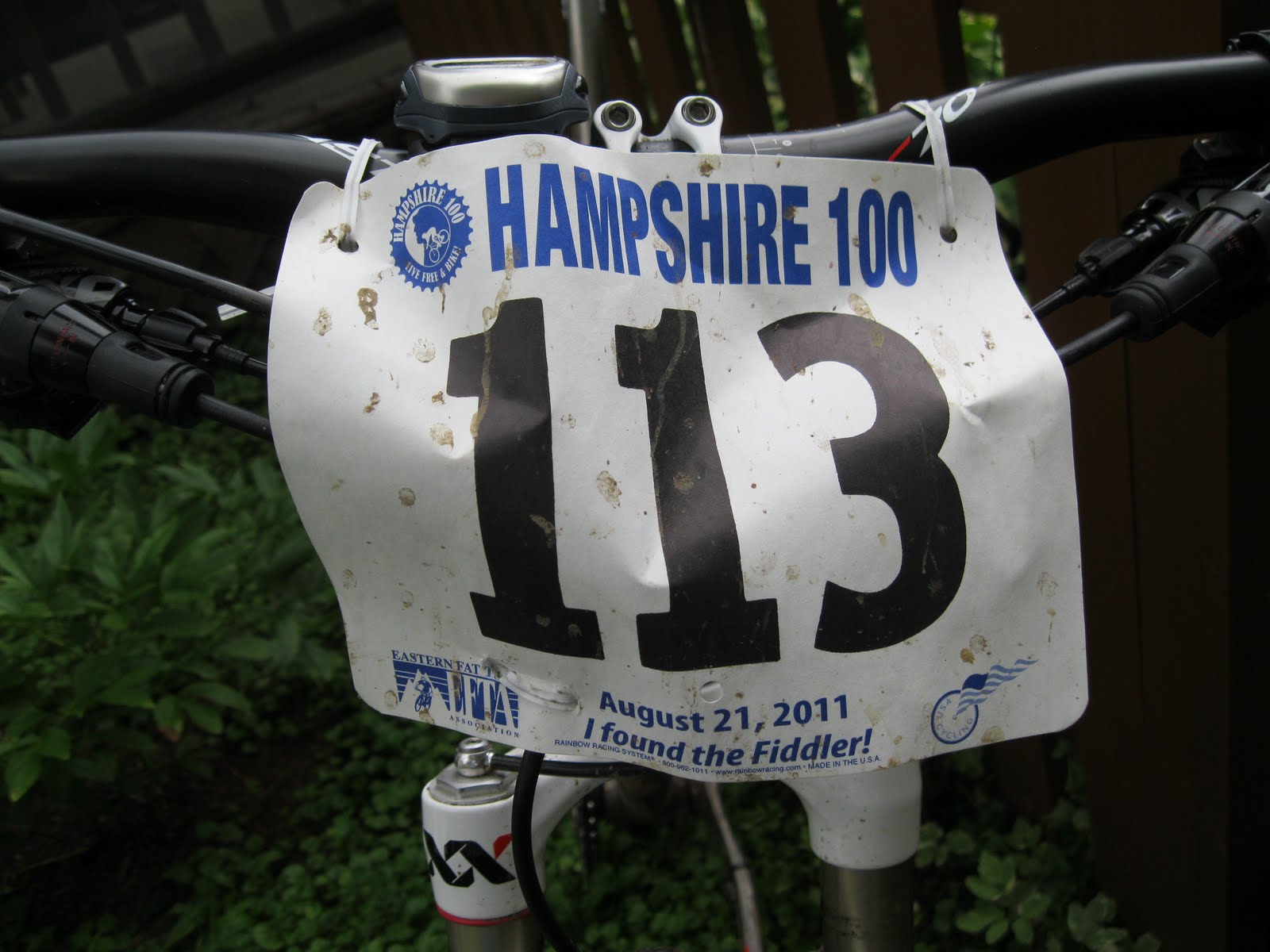
Hampshire 100 Race Report


Last year, the Hampshire 100 was the focus of my season.  After successful campaigns in '09 and '10 I decided to make it my focus again this season, but you already knew that if you read The Moment post that I published last week.

Going into the event I established some goals for myself.  I wanted to improve on last year's time, but I know from other events that aiming to shave off too much just leads to disaster and disappointment.  With last year's finish time just under 7 hours I figured on a goal of 6:30, but that I'd be happy with 6:45.  Also I wanted to beat my H100 nemesis, the racer who'd won in 2009 and finished one ahead of me in 2010.  It wasn't anything personal, but I wanted to make up that 5 minute difference he had on me last year that kept me off the podium.  

This year is a little different because I've already done 2 decent endurance events, 6 Hours of Pat's Peak and the Dark Horse 40.  My preparation featured fewer long training rides and more racing action.  Sometimes it works out, and sometimes it doesn't.  

Friday and Saturday were pretty laid back but productive days.  I was able to get my bike dialed and round up most of my gear with little incident.  In some ways it's a shame to have a summer Saturday assigned to packing the car, driving and basic pre-race tasks, but it's a necessary evil.  

I arrived at the venue Saturday afternoon and after some deliberation spotted an appropriate spot to pitch my tent.  After a brief debate I elected not to setup next to shirtless guys and instead found a quieter corner away from the commotion of the start line.  I'm sure those guys were decent people, but the fact that one of them was going to ride 63 miles on a Klein Mantra was enough to make me suspicious.  

The tent went up without a hitch, and at 8:30 I had nothing better to do than go to bed.  After thumbing through the pages of Cyclocross Magazine for a few minutes I shut off my lantern, set my alarm for 5:15 AM and attempted to get some sleep.

I'm usually pretty restless the night before a race, especially when I have to get up early.  After lying restlessly and fumbling around for what felt like half the night I decided to get up for a bathroom break.  When I made my way back into my tent I was certain it was around 2:30 or 3:00 AM, but it was only 10:30 PM.  

When my alarm finally went off I slowly started to get ready.  I've done enough races that I have a pretty decent idea of what needs to happen in what order, so I was on semi-autopilot as I got dressed, had breakfast and pulled my bike out of the car.  

The dew was pretty heavy, and everything that had been left out was soaking wet.  I'd learned that from years past and had put the bike and my folding chair back in the car to stay dry.  
 
I was able to sneak in a quick warmup before the mandatory 6:15 AM racer meeting, though I could have ridden longer.  The expert lineup was pretty big and by virtue of lining up late I missed out on getting my preferred starting spot, but I made do.  When the gun went off we rolled away and quickly zipped through the short singletrack that connected the cinder track to the dirt roads outside the park.

This is the point in the race when the fast guys light it up, and everyone else turns themselves inside out to keep pace.  Some groups form, guys work together in pacelines, and many racers bury their chances of a solid finish by burning too many matches within the first 10 easy miles.  

It's tough for me to sit back when I know I can keep up with those guys, but I know what I can and can't sustain, and I have no business wheel sucking when it's just going to bury me later.  This year I kept up a little better than in years past, but my legs felt awful tight, and I was regretting wearing arm warmers after about 15 minutes.  

The miles click by pretty quickly in this section, and it's easy to entertain thoughts that you can finish in under 6 hours.  Really until the 3 mile sand section that's pretty much true, but then reality sets in.  

The race follows a pretty similar pattern every year- flat, fast first half, then two big, steep climbs and then the second half is on broken class IV roads, jeep roads, vague doubletrack and singletrack in that order.  The second half doesn't have many big climbs, but there are many steep power climbs, many of them on loose rocks and with a water crossing at the bottom.  Not surprisingly the second half is where the real race really starts.  

The break point between those two halves is the first big climb- a very steep, long and gravely ascent that takes probably about 15 minutes to climb.  This climb is immediately after the extended soft sand section, so although you haven't been going uphill you have been building fatigue.  Last year I made up some time as I was able to ride most of the climb; this year I rode all of it. 

Photo courtesy of extremilys

This shot was taken near the top where it flattens out a bit but is still pretty loose.  The camera angle makes it look less steep than it is, but more than half of the riders bailed on it because they lost traction.

At the top of the climb is a smooth, fast rolling section that sets you up for the next big climb- the Powerlines.  Steep, grassy and wet, the Powerline climb makes its way up a long hillside just a few short minutes after you've crested the boulder field.  It's steep, and with my 2 x 10 29er I have 3 less gears for tackling extreme uphill grades.  Still, I kept it rolling and went into the red to keep pedaling and reel in some riders where most were walking.

Shortly after the climb is the first aid station, and I made quick work of filling my bottles, inhaling some salt tablets and getting back on my bike.  I don't do well with stopping, so I try to keep my breaks pretty short, but even still I felt like my legs were getting really bogged down as I made my way up first climb.

By this point, the race is fairly strung out and I've settled into a groove within a pretty small group of riders around me.  For me this is where the race really takes shape as I usually aim to have a fast second half.  I'd been feeling alright, but the technical sections weren't really smooth, and I felt like I was getting a little too tossed around on the trail.  After letting some air out of my tires at around mile 35 things started to change.  I felt good.  I was fast, smooth and able to ride both up and down.

At some point I started trading places with a particularly lanky fellow on a Pivot.  He was about my height, but his saddle was several inches higher than mine and his riding style was to pedal roadie style with a flat back and let his big wheeled suspension bike do all the work.  He was light on torque, but his wiry frame enabled him to keep pace on longer climbs.  From behind he looked like a praying mantis with his long legs and folded over posture.   

Last year I ended up racing a fair bit of the last few miles with a guy in a Racer X jersey.  This year I found myself trading places with him a little earlier, and he quickly became my rabbit.  X had rolled away from me a bit and was working with another rider.  I tried to make up some time in one of the steep rocky sections and went over the handlebars while over thinking a roll down.  As I picked myself up off of the dirt Mantis rolled by.  Mad at my momentary lapse of judgment I put in a concerted effort to catch up to X and his partner, and a few minutes later I did.  With some smart line choices I was able to save some matches and pick my way back up to him without burying myself.

For the next few wooded miles we traded places- sometime I'd lead, sometimes X would, and we'd intermittently catch and pass Mantis.  I was running low on water and stopped at the aid station before the second drop station to fill up.  Although it was only 9 miles to the next station I knew 1 bottle wasn't enough.  That gave X and Mantis a couple minute head start, so with full bottles I began to chase back on.

The next few miles after that section feature a fast descent, some climbing under the power lines and more wooded semi-smooth singletrack.  I got within a few bike lengths of Mantis, but X was much further ahead.  We worked our way past some low lying ponds that were right near the roadway, which meant that there were some enormous puddles.

In one spot I slowed down to pop a GU, and looked up to find Mantis riding out of the biggest puddle I've ever seen.  With a clean line in front of me, I rolled into it as the water parted around my front wheel.  At the deepest point my shoes, pedals and lower brake rotors were all submerged.  A few short seconds later I was out of the puddle and accelerating to catch back up to Mantis.  We rode together into the next aid station and readied ourselves for the push over the last 15 miles.

The distance after this last drop station is really where you can feel that it's a different race than the Vermont 50.  That extra 13 miles means you still have to race for at least another hour, and it's an hour at the end of the race when you are already pretty spent and really just want to get off your bike.  It's also where I usually pick off a few more riders who slipped by me earlier in the event.

Shortly after the aid station X stopped to walk up a hill and I never saw him again.  A few miles later Mantis did the same, and I found myself racing with some other riders who had started hard but were fading fast.  We rolled together for a few minutes before I let it all hang out on the fastest, roughest gravel descent I've even ridden. 

I'd promised myself I wouldn't check my watch to see my time until I'd finished, so I poured whatever energy I had left into riding as smooth and fast as I could.  Fortunately the last couple miles were on fairly smooth singletrack so I was able to conserve energy and let the bike do the work.  Without incident I rode most of the singletrack clean, although I walked over a couple of the bridges in the last section just to be on the safe side.

In the end I had good but not great race and finished in 6:44.  I did beat my rabbit, but because of a large number of sandbagging elite riders that was only good for 9th.  Still I'll take it, even though my finishes of 3rd, 4th and 9th seem to show backwards progress but in reality it's just the opposite.

What's probably the most interesting thing for me is that after I found the groove I not only rode better, but I could go faster than I though was possible.  As I packed up my tent I was amazed that although I was tired I wasn't nearly as beat up as I was after finishing last year.

So was it a victory of the body over the mind?  In some ways yes, I think so.  I also proved to myself that I'm stronger than I think I am, and that my training is paying off.  The effort put into big rides and doing other races has made me stronger and more resilient than years past.

There's one more race on my calendar, the 50 mile Landmine Marathon next month, but for now I'm going to be taking it easy for a few more days before I ramp it up again.


Monday, August 1, 2011

Dark Horse 40 Race Report

There is a distinct pattern in my preparation for and recovery from an endurance race.  This past weekend's Dark Horse 40 featured all of usual fun, neuroses and caloric intake of my usual endurance activities. 

The week didn't get off to the best start as I had a nasty crash on Tuesday's ride.  I didn't get stitches but probably should have, and I broke a shoe as well. 


The Dark Horse Cycles guys put on a few events that are as well known for their antics as they are for their racing.  To some people antics are more important than racing, especially if you're a singlespeeder. 

The race format was fairly straightforward and consisted of two laps on a rolling 20 mile course.  In high school I did a few races at the same venue so I had some idea of what to expect- fast, rocky technical sections, some water crossings and short but very steep, punchy climbs.  That was mostly right, but since 1998 they’ve built out the trail network to include many more miles of sinewy singletrack under the thick forest canopy. 

When I arrived I was directed where to park and got the sense that there was some sort of regional bias for the assignments, though I couldn’t really gather any empirical evidence to support my theory.  I ran into local Grass Moots rider George and his partner in crime Mark.  We talked about my RSL and geeked out for a bit about Moots and bikes in general.  George is one of those unassuming guys who seems perfectly normal but can ride a singlespeed over anything and is hearty enough that he could probably survive on a diet of lug nuts and tree sap.  I unfortunately am not that diesel and will be sticking to my cottage cheese, chef salads and strong coffee. 

After a brief warm up and several Red Bulls I coordinated with Mom & Dad for the staging of my water bottles in the feed zone.  Dad was kind enough to get up at 5:00 AM that morning to make some of his famous pancakes.  Dad's pancakes are some of the best legal performance enhancers you can find- just ask World Cup racers Adam Craig and Kathryn Curi Mattis. 

I lined up towards the back of my field, which happened to be Men's Elite Open, but only because there wasn't a Cat 1 option.  This doesn't count as making the grade in elite partially because I am still a Cat 1 and also because I got smoked relative to the real pros in attendance.  The air horn went off and the field thundered down the long gravel road.  The dust was incredible, and I managed to be in the optimal position to catch 90% of the spray from the one mud puddle that was on course. 

40 miles is not a distance I've ever done before, so I was unsure how to pace it.  After some conversations with Spinney I came up with a strategy that sounded good based on what I thought I could sustain for the roughly 4 hours I planned on racing.  Together with the 90+ degree heat I was unsure how to meter my effort, so I went for a conservative strategy on the first lap. 

The combination of the heat, race nerves and too many Red Bulls (3) made it hard for me to find my rhythm on the first lap and I ended up bouncing off of most obstacles and letting riders pass me who I probably could have stayed with.  In most of my races that run 6 to 8 hours  the start is the least important part, and the race really doesn't take shape until the second half.  With that in mind I decided to start a little more conservatively and let the course and the heat soften up the field. 

That strategy mostly worked, but the aforementioned cocktail of heat and caffeine made it hard for me to determine my actual effort since I felt like my heart rate was artificially elevated.  The first lap went smoothly enough and I found myself relearning how to manual and using it all the time- the Small Block 8's make the coolest sound when you drop a rock face.  It’s like something out of Transformers. 

As I completed lap 1 I found Mom and Dad in the feed zone and pulled three full water bottles from the cooler that they had waiting for me.  I debated about whether I needed all three bottles, but given the heat I decided to play it safe and bring all if them anyway.  In less than a minute I got what I needed and rumbled back out onto the course for lap 2. 

At a certain point I stopped thinking about the terrain or my pace and just started riding.  Right at that moment things clicked into place.  With very little effort I was taking the right lines, maintaining my speed and pushing the gears I'd expected.  Also at that point the race became a hell of a lot of fun.    


Note the flapping band aids on my left arm from Tuesday's crash. 

The Dark Horse guys also provided a fair number of distractions like attractive young women standing by a keg.  Usually when I'm three hours into a race I'm pretty sick of seeing sweaty, muddy dudes, and Godzilla's sister would look good if she was wearing a tube top.  Fortunately I was able to resist the temptation (of the beer) and kept riding. 

In the last half of my second lap I started to really pass some people- some of them walking, some soft pedaling, and I was making up places that had slid by during my lap 1 freak out.  I was still feeling good and picking good lines as I pushed the pace as hard as I could in the home stretch. 

The last 5 miles for me are often the toughest, but if I'm in the pain cave then I know that I've given it a solid effort.  Right on the last short road section before the last piece of singletrack I got caught by two guys who were clearly in a battle with each other.  The lap was somewhat deceptive because the course went right past the parking area before heading back into the woods for another half mile or so.  Right in this paved faux finish one of them asked me where the finish was.  Great I thought- these guys are team racers who haven’t done a lap on the course but they're hell bent on killing each other right in front of me.  They took turns attacking each other on the trail as I tried to keep contact.  I got gapped on one of the short rock wall sections and they ended up finishing about 15-20 seconds ahead of me. 

After the race I fumbled around and collected my empty bottles then made my way over to the beer tent.  Although I was unable to formulate complete sentences the EMT manning the keg was able to interpret my needs and handed me a cold Harpoon.  It was the best thing I have ever tasted, even if it meant that I was half drunk before I had even taken off my helmet.


Back at the car I put on some clean-ish clothes and managed to sweat through my t-shirt before I stuffed my bike into the trunk.  With decreasing cognitive capacity I made my way back to the beer tent and caught up with George and Jay Pro for a while before sitting down with Mom and Dad in the shade and coming to my senses enough to drive home.  I had less than two beers in two hours, but in my weakened state I felt like a 14 year old that had raided his parents liquor cabinet.  Ironically enough I was in front of my parents. 

I said my goodbyes and sat in the car for a few minutes with the AC cranked to try to cool down.  As my body temperature started to come back to normal I thought about how I would replenish my caloric debt and reward myself.  The answer soon came to me: Doritos. 

After a quick stop for a sandwich and fuel I located a family sized bag of Cooler Ranch and proceeded to stuff them into my cake hole as quickly as possible.  At 10:45 I polished off the bag before I brushed my teeth and went to bed.

I consider that a successful weekend of racing. 

Friday, July 8, 2011

Time to Sack Up


It's been over a month since my last race, and I've decided to head to Windham this weekend.

My training and recovery have been going well...sort of.  My form has been good- I set a new PR up Bolton that was 20 seconds faster than by previous best, and I had the rear brake dragging the whole time.

So what's the problem?  In the meaningless midweek training races I haven't had a good day out in a month.  Part of that is by design to prepare for and recover from Pat's Peak, but some of that is attributed to weather and laziness.

Last week I crashed hard on a slick downhill corner in my warmup, and it shook my confidence enough for me to be completely skittish on all of the wet, grassy turns on the course...which is basically the whole course.  This week I did the App Gap/Bolton double on Monday and was still in recovering on Wednesday.  The weather also sucked, and I didn't get a good start or a good warmup, so when I got tailed off the group at the top of the first climb I decided to pull the plug.

Last night I went with the shop ride and set the pace on the climbs (I know, I never thought I'd say that either) but a mechanical problem forced me to walk out of the woods for the second ride in a row.  I never got to test myself, and my real goal was to rediscover my technical skills by following better riders.  

The hard part is not letting these things get to me when I know that I'm in good shape.  It's the mental game of riding confidently and smoothly, and getting back on the horse when you fall off.  Because you will fall off.

This weekend's event is a combination World Cup and citizens event held on the same course in Windham.  The non-UCI event is called "Race the World" and is part of the well-run Root 66 New England series.  Fortunately I don't have to race the world, just the rest of the dudes in the Mens 30-39 Cat 1 Masters field.  

Many times before I mentioned that I'm an endurance guy, and I haven't done a standard distance XC event in three years.  I really don't have any expectations beyond seeing how I can do with decent preparation, so
I'll take my decent from and questionable skills to the start line at 8 AM on Sunday.

As I'm getting ready I will remember what Myles Rockwell had to say about becoming World Champion:


“Let the auto pilot click on and let the red light flash, that is the only way to describe it. Grit your teeth and pin it."

Friday, June 17, 2011

Race Report- 6 Hours of Pat's Peak

Last Saturday was 6 Hours of Pat's Peak, and I'm glad it's in the rear view mirror.  The picture above illustrates both the start and how well my preparation went in the week leading up to the race (I'm in the Moots kit in the foreground- notice how far ahead the rest of the field is already at this point).  

All of the other endurance races I've done are the traditional point-to-point format, which is basically one big  50+ mile loop, and although the time on the bike isn't that different for a time-based event, the rules and strategy are.  There are some inherent benefits to doing laps on a 5 mile course, namely that you get to know the terrain and that it's much easier to stage technical support and fuel stops.  There's also less chance you'll go off course like I've done in the Hampshire 100 and the VT 50.  The downside is that you can feel like you're treading ground and it's easier to mentally fatigue once you get accustomed to your surroundings. 

The week leading up the race I was wracked by my usual pre-race existential neuroticism.  Was I ready for a ski area race?  Would doing repeated long climbs really be a good idea?  Was 800 vertical feet per lap going to kill me?  Was I going to get my ass kicked?  Was there anything on the course that suited my strengths?  Would the weather hold out?

And I procrastinated.  It was a busy week with work and training, but I also procrastinated to the point where I was still getting my shit together at 10 PM Friday night.  I made sure the bike was ready earlier in the week, and I made sure I had all of the necessary supplies, but I didn't do much to help myself out otherwise.  Miraculously I got to bed around 11 PM. 

The forecast first called for a high in the upper 60's and a 30% chance of rain.  Then it was high of 65, 40% chance of rain.  Then it was a high of 59, 50% chance of rain.  I had been running the Kenda Karma exclusively, and so far I was happy with its performance in both wet and dry conditions.  With the mixed bag forecast and semi-unknown terrain I decided to stay with the Karma as it's versatile enough to handle almost anything, and it's light enough to climb well.   

On Saturday it quickly became apparent that the question wasn't if it would rain, but rather how much and for how long.  As I drove down to Henniker I was glad that I had packed my PVC rain shell, shoe covers, embrocation and an assortment of cycling caps and other wet weather gear. 

Normally it's important to stay cool during a mountain bike race, and most equipment like helmets, shoes and gloves are designed with that goal in mind.  Fortunately I didn’t have to worry about overheating, but I was a little concerned about how I would stay warm enough for 6 hours riding at endurance pace.  I settled on the usual jersey and shorts combo, but opted for shoe covers, a light wind shell and a cycling cap for my warmup.  Oh, and of course embrocation. 

If you're familiar with the rules of multi-lap endurance racing then you may want to skip down 3 paragraphs, pass "GO" and collect $200. 

The basic rules for a 6 hour are derived from 24 hour race guidelines, and they're an interesting mix of NASCAR-style pit support, Johnny T-era NORBA XC and ultra-endurance.  In a 24 hour race it's likely that racers will take breaks throughout the event to fuel up, fix their bikes or even take a nap- especially if they're competing solo.  Normally the fueling happens at aid stations where prearranged drop bags are waiting for you, and any repairs are done on course with tools you carry or have stashed in a drop bag.  With a 24 you have the ability to setup a single stash for fuel, tools and spare parts, and you can stop on any lap to access it. 

The most notable difference is that you can leave the course during the race, which I've never been able to do for any other event.  As long as I completed at least 1 lap I could leave my bike at my car, take a shower and sleep in the lodge for a couple hours.  The only catch is that you need to be on course when the race ends or you DNF, but how you spend your time between the start and finish is entirely up to you.  Also you need to dismount every lap and walk/run/crawl/trot/skip through the timing tent to record your lap. 

Solo riders were given a baton, which in my case was a small wooden dowel marked with electrical tape with my number written on it.  This baton needed to be shown to the race officials as I jogged through the timing tent pushing my bike.  More on that later. 

The start was a Le Mans free-for-all, with teams and solo racers of all ages, categories and race distances running for their bikes like soldiers in Bronze Age combat, minus the war whoops. 

I'm a shitty runner, as the picture above will show, and I promptly converted a prime starting spot on the front row to the back end of the field.  Most of that was by design- I knew the course was going to wear people down and that this was going to be race of attrition.  I also didn't want to burn too many matches, pull a muscle or god forbid stumble and fall in my superlight carbon-soled race slippers.  Those shoes are wicked light, but they're oil slick sketchy for anything other than being clipped in and pedaling.

So I started up the first climb at the back of the field, which is pretty normal for me.  What I didn't plan on was being behind racers of all abilities (i.e. chuckleheads) being in front of me and slowing me down on the singletrack.   Still, endurance races aren't decided by the holeshot, so I patiently made my way around other racers and slowly moved up. 

The course was actually pretty well laid out, and for a ski area it was not just the typical uphill grinding climb then puckering descent.  There were definitely two major sections- one up, one down, but the course was broken up enough to be interesting.  It didn’t feel at all like I was just climbing, which is a compliment to the course designers. 

Through lap 1 I was mainly just trying to get my bearings and stay upright while keeping the balance between passing riders and not burning too many matches.  My lap 1 time was alright, but it was clear that it was going to be all mud, all day long. 

My first trip around the course was a little unnerving as everything was slick.  I was also a little anxious about the dismount/run/wave baton/remount routine necessary for each lap, but it went fine and the timers didn't seem to care whether or not I could find my solo racer baton- merely the act of fumbling for it was enough. 

On lap 2 I kept a steady tempo and rode slightly more smoothly over the obstacles since I could actually pick my line and wasn't riding in traffic.  There were still some other riders around, but I was starting to settle in and find my groove.  I stopped briefly and grabbed to 2 full water bottles and filled my jersey pocket with GU packets.  I caught a rider on the climb whom I'd passed on the climb on the previous lap.  He'd then passed me on the downhill, and I was reeling him in on the uphill.  What surprised me was how much time he put on me on the downhill, but also how quickly I motored by him on the climb.  That's right- "how quickly I motored by him on the climb."  I never thought I'd write that sentence comparing myself to a mailbox, late alone another cyclist. 

As I headed out on lap 3 I could see that the course was really starting to degrade, and sections that had been muddy but rideable were taking progressively more effort with each lap.  Amazingly enough I was catching riders on the climbs, and I suppose that's mainly because I had settled in on riding steady on most of the course but would go into the pain cave on three distinct short uphill sections per lap.  It wasn't that I was even climbing well, but I was mentally ready for the effort and knew where I could recover.  I also let some air out of my tires and went from being mostly kinda OK on the slick stuff to feeling like fucking Spider Man.  Not Turn off the Dark Spider Man, but the legit web-slinging hero from comic books of yore.  It made an immeasurable difference on the downhill. 

My fueling plan was to grab 2 bottles every other lap, which meant that I cruised out on lap 4 without stopping.  The course itself was slowing down dramatically, but I felt the best on laps 3 and 4, and had the conditions been stable I bet I would have turned in my best lap times then as well.  Lap 4 was otherwise unassuming- I was alone for all of it.  I passed an Embrocation rider when he flatted just moments after he'd motored by me. 

What's cool about the solo category is that people are very supportive.  I had some questionable interactions with some team riders who were out for blood with their hairy legs and 5" travel bikes, but the solo guys were all fit, relaxed and respectful.  

My quick pit stop included a quick bike check, and I doused the drivetrain with some water to clean it before applying some T9.  I grabbed my new bottles from the cooler, chugged a Red Bull, stuffed 4 more Gus in my pockets and took off. 

It all came apart on lap 5.  The fatigue set in, and I felt like I was cracking.  I had to walk a few sections that I had been riding, and I just felt empty.  I kept pushing, and had to walk more than any other lap.  The pain caves were brutal, and I didn't think I could keep it rolling. 

As I bumbled down through the descent and onto the finishing stretch I looked at my watch and thought that I could get another lap in, so as soon as I did the dismount/wave/remount/sprint shuffle I locked out the fork and pinned it to get to the top of the first climb. 

I'd been pounding GU trying to fuel back up, and I knew that the course was only getting worse, so my goal was to ride the technical sections as smooth as possible and to ride all of the climbs no matter how much they hurt.  As I made my way to the top of the second climb the Embro guy caught me.  He wasn't quite motoring, but he was riding quickly enough that I couldn't stay on his wheel.  It was still raining, and he was still not wearing gloves, though honestly I was getting pretty sick of mine at that point as well. 

My lines were smooth and I rode every technical section smoothly, except one.  The wet, sketchy, dual fall line (off-camber) downhills ate my lunch all day, and they continued to frustrate me to the end.  I have no idea how anyone got down them with any speed without being scared shitless.   

As I apexed the corner at the bottom of the last turn I jumped out of the saddle and surged up the short hill towards the finish line.  In my head it was like Rocky, but to the spectators on the side of the trail it was probably more like watching sea turtles coming out of the water and up onto the beach. 

I crossed the finish line 6 minutes too late for my last lap to count, so I only got credit for 5 full laps.  If I had managed to trim off 6 minutes (which over 6 hours is very possible) I would have been 7th rather than 10th. 

Given the terrible conditions and unsure of my form I think 10th is a solid result.  My bike was in rough shape, but the chain is still usable and the brakes still worked.  Remarkably I didn't have a single shifting issue all day, which is a testament to the engineering of SRAM's 10 speed offroad drivetrain. 

The RSL performed beautifully and gave me a stable platform and predictable handling to navigate the very slick parcourse.  Whenever the bike slid it was always controlled, and I felt very confident. 

Maybe I wasn't going fast enough.

Monday, May 23, 2011

Absalon, Part 3

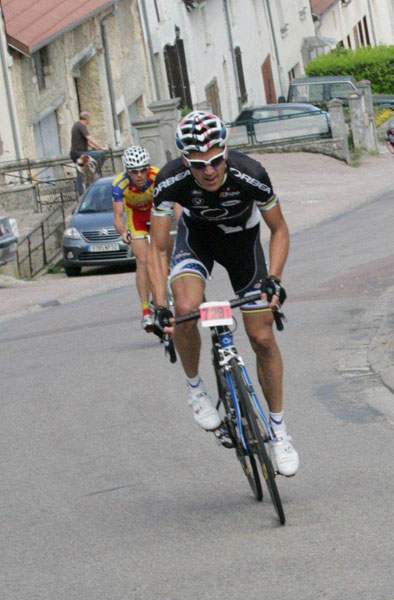
In a country full of roadies how do you get to be the best mountain biker of your generation?  I'm not sure, but Julien Absalon could tell you, and I'm sure he spent a lot of time training on the road to get there.  Case in point is this picture from an early season road race in France. 


It'll be interesting to see if he runs a 29er hardtail at the World Cup this year, and I guarantee if he does that many others will follow.  

Monday, May 16, 2011

Another Step Closer

The weekend worked out in what has become the new normal standard, which is to say that my initial plan went completely out the window.  Still, I made some progress and think I made some good on-the-fly decisions.

The weather was pretty bad over the weekend, and bad enough for me to decide not to race on Sunday.  After Saturday's damp preride of the course at Catamount I decided that for a variety of factors the best call was to not race.  The track was rideable early, but with another inch of rain in the forecast for the next 24 hours it would only get much, much worse.  

Yesterday I got the wheels laced up for the RSL.  I went with my King ISO disc hubs with silver spokes, silver alloy nipples and Crest 29'er rims, which is basically a bigger version of the wheels currently on the YBB.


So here's a shot of the YBB post hosedown, pre clean, adjust & lube.  As I'm planning to get the RSL rolling this week I wanted to give this bike some attention as it is sure to get neglected. 

Thursday, April 21, 2011

The Road Toolkit

 
I hate saddle bags.  It's not that I think that they don't have a purpose, but I just think that they detract from the simple aesthetics of race bikes.  Earlier I mentioned my byekyle simple strap solution for the mountain bike, so here is my saddle bag- free solution for the road.  

Like most competitive mountain bikers I spend a fair bit of time on the road, and this time of year that's the only option.  My long training loops bring me through some remote areas where I'm a long way from the sag wagon and I need to plan accordingly.  

A few summers ago I had a stretch where I was going through 2 inner tubes a week.  I attribute that to a bad batch of tubes, but in one particular instance I flatted once, fixed it, then flatted again ten minutes later.  Since then I've been better prepared.   

The contents of the bag are pretty simple: two tubes, a vulcanizing patch kit, a pump and a multi tool.  CO2 is great for fixing one flat, but after getting multiple flats in a single ride I've decided to carry a pump to make sure I can always get rolling again.  There are about ten patches in the kit, and by the time I've used about four of them I've probably already thrown the bike in the woods and started walking anyway.

The Crank Brothers multi tools are the best I've used and I carry one with me whenever I ride.  Chains fail on road bikes and it's important have a chain tool in addition to the standard assortment of hex wrenches, spoke keys and screwdrivers.  Often I'll tuck a couple dollar bills into the rubber ring on the tool.  Spare change goes inside the patch kit box.

All of this fits neatly into a Thomson stem bag which I've labeled as "Road" to distinguish it from my CX and MTB kits with different tube sizes.  Altogether this is a good solution that has me prepared without an unsightly saddle bag.   

Saturday, April 2, 2011

The Message


 Last fall, I decided that I was going to make the effort to get my elite racing license.  On paper, I race in one category below the elite riders.  Although it seems like a small step, in reality it's a huge difference.

After I made the decision, I  told a handful of friends and family members about it.  Everyone was supportive and enthusiastic, but I think few people really knew how hard it would be.  I'm not even sure that I knew myself. 

One of my friends who did know was John.  In college he put a massive amount of energy into his racing career, first on the mountain bike, and later on the road.  Through his own mix of analysis, determination and work ethic he worked his way up through the ranks and won some big regional events. 

A few years and several new responsibilities later John is still riding, but not actively competing beyond an occasional cyclosportif.  When I visited him earlier this year there were some very obvious ironies, primarily that  John had the fitness while I had the goals.  When we rode together, John was always stronger, especially on the uphills. 

It wasn't that I was terribly out of shape, as I'd spent the winter skiing.  All things considered I felt pretty strong, but in early March I clearly didn't have much mileage under my belt, and certainly not outdoor mileage. 

During my two-week trip we did a ton of riding, roughly 300 miles with over twenty thousand feet of vertical gain.  I've posted many pictures from those rides and I'll remember them for years, but what the pictures don't show is what really happened during that trip. 

Whether knowingly or not, John pulled me along for most of those rides.  I never bailed or gave up, but I certainly didn't set the world on fire.  He'd ride ahead, and I'd push myself to keep up.  The power files reveal that the pace wasn't entirely above what I was capable of, but it was a stretch, and that was the point.  If I wanted to get faster I had to push it and ride at a pace above what I thought I could handle. 

I didn't put it all together until I'd gotten home and had a few days of rest before getting out for a ride on familiar roads.  More than anything else I felt fast, and I felt purposeful. 

The feeling of being "in form" is hard to articulate to non-cyclists, but it's basically  the difference between having everything go right compared to feeling like you can't get out of your own way.  You don't feel invincible, and you don't even necessarily ride that much faster than normal, but inside your head there's the incredible feeling that things have fallen into place and you're being rewarded for all of your hard work. 

This past Thursday I did one of my normal mid-week training loops.  My original intent was to do the loop at a reasonable pace and make it home before dark.  As the miles slipped by I realized that at I was flying along while staying within my predetermined pace and within striking distance of my PR for the loop. 

By my calculations I took over a minute off of the mark I'd made six years ago when I was arguably in the best shape of my life.  I've had other good days on the bike and have set other benchmarks, but when I think back on that ride it always seems like it was a fluke.  One hour and twenty-seven minutes were possible for a mostly flat 28-mile loop, and it meant an average speed over 19 miles an hour, solo, on a standard road bike with no aero equipment.  That's not Herculean, nor barely average for any self-respecting middle category road racer.  For me it's a big deal, and a step in the right direction as I slowly prepare to compete this spring. 

Although I didn’t realize it at the time, John's message was clear--you can do this, but you need to work and you need to push yourself.  All at once it was encouraging and supportive, but delivered with an honesty that I'd shielded myself from when I looked in the mirror.  More than anything else, it was what I needed, and it's not something I will soon forget. 

Sunday, March 13, 2011

Marseille Cyclosportif/Baconator Pictures, Part 1


We'd gotten out of the car, then promptly started on the first Col.  I had no idea I was riding on the Ocean- I was too worried about not getting drilled by oncoming motorists.


Climbing.  Slowly.


Slowly.  Climbing.

  
You can almost read the screen on the Powertap- "PEDAL FASTER."

Still climbing.


 Wait, how much further is it?


Summit.  Amazingly there was another pro-35 blogger who put a sticker on the sign. 


 This was the descent that awaited us. 


Starting the descent.  


Partway down, wondering why John isn't right behind me.


Baguette & Coke stop at the bottom of the best descent I've ever ridden.  Notice the box of baked goods I'm inhaling.  I was fortunate enough to find some amazing home made muffins at this little store.  As I stood at the register I debated about buying them, and the store owner sold me with the fact that they were "tres bon."  They were indeed tres bon, and I had 2 of the 6 before we started again.

More to follow...

Saturday, March 5, 2011

Toulon, Ride #3

Today the plan was to do a short ride to preview the first climb in tomorrow's long ride.  Long and short are relative considering this is my fourth ride outside this season.

This is the view from John's balcony.  The RC Toulon Rugby stadium is in the center of the frame.  Note the stuffed tiger and Lay-oh-pard (that's for you, Andy Schleck) in the window on the right.  Not sure what's going on there.


We headed out with Matthias, a Swede who's working on a doctoral program in town.


Matthias on the left in the green kit, John on the right on the Hinacapie development kit.  John's asking Matthias what he prefers for his post-ride Aperitive.  


This was pretty much my day- riding behind two skinny guys trying not to get dropped.


Tourists.


Alright, I took a picture of it, too.

Somehow after feeling like I turned myself inside out for 5 hours I still have little to show for it on the power tap.


What's so interesting about that?  Nothing, other than almost 3,000 kilojoules of work, which for March is unheard of for me.  Normally this time of year I'm skiing, riding the rollers as much as I can stand and trying to avoid Carrie's chocolate chip cookie dough stashed in the fridge.  That's usually all on the same day.

Friday, February 11, 2011

Does This Mean That I've Arrived?

This week I decided to search for this blog through Google, and I was amazed at what I found.


No longer does my blog show up after a couple pages of 35 mm camera links, but as the first option when you search for "pro 35 blog".
 
Truth be told, my father-in-law gave me the idea to start searching for pro 35.  He had forgotten the url and was trying to find it, but couldn't.  Since then I've made Google search results a pseudo-benchmark and something to strive for.  

Does this mean that I've arrived, or just that I've been active enough on the interweb to have Google recognize my existence?  Hard to say, but regardless I'm psyched about it.  Earlier this month I passed another milestone- 2,000 unique page views.  Not a huge number, but considering I didn't even start this project until mid-September I'm pretty happy with it.  Hopefully I can keep the momentum going through the season when I have real things to post about like training, racing, my new bike, and so on.  This is a one man, part-time show, but it's been a great creative outlet for my cycling geekitude.  In the process it may have even helped my marriage.  No longer is Carrie inundated with incessant cyclo-centric banter; now it's just intermittent.  

Maybe you've stopped by because you're a bike geek like me and are starved for online cycling content in the wintertime.  Maybe you've stumbled upon these pages because you know me, or have raced with me somewhere along the way.  Maybe you are a closet nordic geek and don't want to admit it to your alpine-centric friends.  Regardless, I appreciate the attention, and thank you for stopping by.  

More to follow...

Monday, September 13, 2010

The First Step

Last night my wife and I went out to dinner. Over dinner and a few drinks we talked about our families, her upcoming trip to Portland and how we thought my brother's new relationship was going. As the conversation wore on I thought about my rides earlier in the weekend.

The day before I was out on a ride and stormed up a climb where I normally suffer. I felt that the strength and speed that I've been training were really starting to show through. This season I've put in a lot of hard miles, and I felt like it was all coming together as I turned the pedals over and made the short but steep climb up to the Trapp Family Lodge.

All I could think about was that feeling, that incredible power that comes when you're on form and that the gratification you've been delaying has finally caught up with you.

That improvement has come from sacrifice. I've weaseled out of family responsibilities, delayed repainting the deck and been guilty of being entirely single-minded at the expense of those around me, namely my wife, Carrie.

With all of that in the background I brought up an idea that I thought was sure to be a dud. "You know, I've been thinking about wanting to turn pro, and I want to write about it." I've needed a creative outlet and this seemed like the a perfect solution to incorporate that with my cycling goals. What happened next was unexpected, and showed me one of the many reasons why I married Carrie. "I think that's a good idea," she said. "And I think if you're serious about it you should take a writing class. And you need to read more."

All at once she was supportive, honest and matter-of-fact. It was as if I'd just gotten my driver's license, wrecked Dad's Ford Taurus, then asked my parents for a Camaro.

If she was on my side, I knew I could do it. At 30 I was getting a late start. I've been at the Expert level for 8 years and until recently struggled to maintain it. Making the jump to pro was the next rung up the ladder. On paper it seems so close, just one level above Expert (or Category 1) but anyone who has made that jump will tell you that it's a quantum leap. It's not just an upgrade, it's a lifestyle change and monumental shift for you and everyone close to you.

This is the first step. This is my story of how I'm going to make it to pro before I turn 35. I know that if I work on the steady improvement that I can do it.