headline

Training, racing, gear, facial hair styles and thoughts from my push to become an elite cyclist.

Friday, April 27, 2012

Getting Fluid, Part 1

One of my weaknesses is trail handling skills.  I can clear most objects and difficult sections on the racecourse, but I often lose time doing it and I have to work really hard to keep contact on sweeping corners, especially when there are several of them linked together.  At the Kingdom Trails last summer with the MTBVT crew my trail flow shortcomings were pretty evident.  

All in all I've spent more time in surfing lessons than I have in mountain bike lessons.  I've worked with a coach to develop my endurance training, but other than countless conversations with various folks in the sport I've never had any formal trail instruction in the 16 years I've been riding and racing.  

Through a complicated but uninteresting chain of events I met Simon Lawton of Fluid Ride during my visit to Seattle.


Simon has built his career around teaching people to ride better and leverages a decade and a half of pro downhill experience and some forward thinking.  As a result he has the best selling mountain bike skills DVD (which will have digital download options through Amazon, iTunes and Xbox in the coming months) and offers private lessons around the Seattle area.  

So what did I learn in my lesson?  For one I've been overcomplicating things by trying to pedal too often and switch up my leading foot.  I've also been riding for a very long time in a head down, roadie-centric attack position with a rounded back.  

First was to get into a more upright, balanced athletic position where I could not only see more of the terrain but also use my legs more to suspend my body over the bottom bracket.  The key really is in the feet and using the pedals and crank to optimize your body position relative to the terrain.  It sounds simple, but I will admit I had a hard time absorbing everything Simon was telling me to do the first time around.  I was in full-on geek mode and still felt like I wasn't getting it all.  

Then it clicked.  


After several cornering drills around traffic cones we started back down a trail we'd ridden a few times before.  First time through I was ahead of Simon and pushing as hard as I could to keep my speed.  Honestly I couldn't have gone much faster than I did.  Second time through things were different and all of a sudden I felt like I was more in control.  

Over the course of a single lesson I'd trimmed about 20 seconds off of a 2 minute run.  I won't even talk about how much of an improvement that can be over a full marathon or even Wednesday Worlds.  My head hurts thinking about how much I'd need to train to pull a similar gain out of my aerobic performance on a pedaling section of similar length.  

Fast forward to my first few rides back home on familiar trails.  Old habits were creeping back in on sections that I'd ridden countless times.  Retraining was a conscious effort, but as I kept riding I was able to clearly see how much better off I was to employ what I'd just learned versus what I'd been doing before.  As I hauled down the steepest and bumpiest trail in the park I focused on relaxing, keeping my head up/looking ahead and making sure I was positioned so my weight was over the bb shell. 

One of Simon's most memorable quotes was essentially to relax and imagine my body as a column of atoms slowly falling down into my socks (and I have lots of matter- good thing I have tall socks).  Thought provoking for sure, but envisioning that made me really focus on relaxing and staying fluid. 

And to top it all off I can see there's plenty more to improve above and beyond what I've done already.  I have no idea how this season is going to be, but I'm going to attack it smoother and faster than I've been before.  

For more information check out www.fluidride.com.

Monday, April 23, 2012

Enduring Hardship

April is a heart breaker.  Weather can be warm and sunny or damp and rainy with an inconsiderate randomness that makes consistent outdoor training very difficult, and of course none of that is any way new or surprising.

So far I've had two weeks of 100% dedicated on-bike training for the 2012 race season.  Sound like a late start?  It's certainly nothing like last year's super intense and nearly perfect transition from long ski training hours into a high mileage training trip in France.  

In many ways I feel like this GTI- plenty of potential, but in need of some work before race day.


March was warm and mild, and in spite of that April is taking its usual sweet time to fully commit to being spring.  I'm really at a point where I need to put my full attention on training so I can't let the weather slow me down.  

But I'm not at a point where I can augur myself into the ground with huge volume in nasty weather either.  The shake and bake training approach has never worked for me, so I'm going to be realistic about my expectations.  I'll be riding outside as much as I can.  Mountain rides will be for skills and intensity, road rides will help with the volume.  There's no way I'll have race worthy fitness for at least another 6-8 weeks.  My first race is the Leadville Qualifier in mid June, the Whiteface Wilmington 100 on June 17.

That first race is really to get used to the event and see how I do without worrying about qualifying yet.  It sounds like it's a very roadie-centric course with a lot of climbing on dirt roads and limited singletrack much like the Leadville event itself.  If I do qualify it will be through the random lottery and not by winning my category.  If that happens I'll have to be honest about my fitness at that time and whether or not I can afford the trip to Leadville.  

The question this time of year comes down to how I go about building the ramp from pre-season to race fitness.  Is it worth it to ride three hours in the rain, or should I ride inside until I hit my sanity threshold there?  Should I drive to Stowe to do hill repeats at Cotton Brook or should I deal with road spray on Duxbury Gap?  Can I legitimately do a recovery ride on trail if I walk the steep hills?  Will I really walk?

So really it comes down to how much I need to train to be ready to race.  It's a familiar position for any athlete, and this week the suffering clock has been set back to zero.  The same engine is still under the hood- I just need to find it again. 


Friday, April 20, 2012

Moots Mooto X RSL Full Review


After a year's worth of use I think I can legitimately publish a review of my Moots Mooto X RSL.  For an entire season this was the bike I rode in every race, every trail ride and every dirt road excursion.  I even found myself favoring dirt road rides on the RSL over mileage on paved roads on my road bike, so that should give you an idea of how fond I am of this bike.

The foundation of the bike is of course the Moots ti frame and matching 30.9 seatpost.  The RSL family has several refinements compared to their predecessors, namely a 44 mm headtube, Press Fit 30 bottom bracket and a 30.9 seatpost.  Individually those changes add incremental stiffness to the ride, but together they really help to fuse ride quality and responsive handling while still keeping the lively ti trail feel.  Frame weight is 3.4 lbs for a 19, and the overall bike as pictured is 22.5 lbs- pretty svelte considering it's a large metal bike used for endurance races with no sketchy light parts.


This is the 2011 model which is technically designed around an 80 mm fork.  The 2012 has been tweaked to include slightly updated geometry for a 100 mm fork and the downtube now has an additional bend in it near the bottom bracket shell.

I opted to run a full 100 mm of travel, which does slacken the bike slightly.  The geometry table will show it's a pretty steep bike, so it's really not a major change.  When the 2012 came out I asked the guys at Moots about the head angle change to accomodate the additional travel they said that it was nominal and that the (mainly cosmetic) change to double curve the downtube was the biggest difference between the two bikes.


Interestingly Velo News reviewed the same model year RSL with a 100 mm Fox fork and they did not report any negative effects of the additional travel either. 

The 44 mm headtube does allow for a tapered steerer, but that adds to the overall stack height of the front end because the lower race needs to sit outside the headtube.  Since I'm running 100 mm travel I decided to minimize the overall change and run a standard straight 1 1/8" steerer.  In my mind the additional travel was more important than the nominal gain in stiffness.


The seatstays feature the trademark Moots monostay and aggressive shaping to allow for tire clearance.  Even around the Maxxis Ikon 2.2 there's plenty of room.


The chainstays have less tire clearance primarily because the chainrings need to clear the outside of the stay.  There is still room for my 2.2, but it's a tighter fit.  The front derailleur is also pretty close to the tire.  I've done several very muddy rides and races and never felt that this contributed to unnecessary mud build up.


The front end of the bike is pretty low slung.  Most of last season I experimented with my positioning mostly to improve my technical handling skills.  I'd read about using wider bars in conjunction with a shorter stem so I tried that out a few months.  To complicate things even more Moots changed their sizing so to get my usual 24"-ish toptube I would need to ride a 19 and not a 20 like my YBB.  Add in a steep seat angle and the longer travel fork and it was too much for me to geek out ahead of time- I had to experiment after I got it built up.  

The good news is that the bike felt pretty balanced and the 90 mm stem was a good starting point.  As bars get wider the reach effectively lengthens (consider how far your chest is from the ground when you're doing push ups with your hands directly under your shoulders versus further apart) so I didn't want to get too stretched out.  

I ran the 90 for several months and it felt pretty good, but when I switched to a 100 mm stem I felt the bike instantly had a more balanced feel.  The short stem/wide bar approach works great for trail bikes or long travel, but the key thing with the RSL is that the rear wheel is tucked in so tightly that it puts a lot of weight over the rear wheel.  As a result I had a few bad falls in wet terrain because I didn't have enough weight on the front wheel to maintain traction.  I could overcome that by aggressively weighting the front end, but that riding style didn't really suit the bike and isn't feasible in endurance events.

The ride quality of this bike is amazing.  I've ridden other 29er hardtails and this one takes the cake with the best handling/smoothness/stiffness combination for cross country racing.  I'm running it with handbuilt Chris King/Stan's Crest rims which are fairly compliant and fit well with the overall feel of the bike.  When I've ridden other wheelsets like the Sun Ringle Black Flag Pro the bike feels quicker and almost shorter (because the spoke windup and rearwheel deflection is minimized), but that also means more chatter on square-edged bumps.

The SID fits well with the overall race-centric feel, but the Reba that preceeded it was a great fork also.  The Reba was easier to setup as the SID is slightly finicky with the STP3 damping cartridge.   Once it's setup it's a remarkable fork and the remote lockout is the best I've ever used.

Overall I would agree with the Velo News review with the exception of their dismissal of the Press Fit 30 bottom bracket design.  The PF30 bottom brackets are certainly the Achilles heel of the bike- they creak and wear out very quickly, but they are also fairly inexpensive and easy to replace.  It's not having a wider crank spindle but rather the larger shell diameter that makes the difference since it allows larger diameter tubes to be welded together.  By doing that the bottom bracket stiffness is remarkably better than standard threaded bb shell ti frames, and to me that's worth the trade off.

PF30 has been adopted by many small builders like Moots because it allows for bigger tubes, and I would suspect that higher quality bottom brackets aren't too far off from companies like Chris King or Phil Wood.  The first generation of GXP bottom brackets sucked too, but they've been improved and I expect PF30 to follow the same path.  And if you really hate PF30 you can permanently glue in an adapter to run a threaded English bottom bracket and pretend this whole thing never happened.

The RSL is not cheap, but it's a great option for a bike that rides well and will hold up.  It's also American made and still offers a lifetime warranty- something that is getter harder and harder to find in mountain bikes.  With all of that said I can say the Mooto X RSL is now my favorite in a long list of high end bikes. 

For more information visit moots online.
   

Tuesday, April 17, 2012

Houffalize

The Topeak-Ergon team published this video on their facebook page.  I know I'll never compete at the World Cup level, but this is very inspiring. 

Thursday, April 12, 2012

Moots MX Divide- Sea Otter Demo

 This year at Sea Otter Moots is demoing their new 29er full suspension bike, the MX Divide.


My Moots fandom is well documented, and I'm certainly intrigued by this new model.  Small companies have made some very cool full suspension bikes in the past- the Fat City Shock-a-Billy and Independent Fabrication Tungsten Electrode come to mind.  There are also small builders who made very expensive, terrible full suspension bikes which are too numerous to count. 

It's difficult for small builders to focus on suspension designs in-house since they don't have the R&D resources like Specialized, Intense or Santa Cruz.  In this case Moots coordinated with the Sotto Group (who also developed the Trek Superfly and Yeti SB66/95) so they didn't have to use someone else's rear triangle or try to invent a relevant design on their own. 

I have to say I'm intrigued by the Divide, so if you're anywhere near Napa next weekend take a spin on one and let me know what you think.


For more details visit the Moots blog.

Monday, April 9, 2012

This One Snuck Up On Me- Diamondback Steilacoom RCX

During my trip out to Seattle I was fortunate enough to borrow Simon Lawton's Diamondback Steilacoom RCX.  It was a great way to get out and see the city, and after a few rides I found myself really liking the bike. 


Steilacoom, wide shot.

What surprised me the most about the bike was how responsive it was under power- when you put the pedal down the bike takes off without hesitation, and the drivetrain/bottom bracket stiffness is great.  Most of that is attributable to the BB30 crank, but upon closer inspection you can also see a well thought out and highly manipulated tubeset that also plays its part. 


Bottom bracket with BB30 stamp.

Most of my riding was on paved rec paths and commuter trails, but I was able to make a couple of dirt dalliances to see how 'cross worthy the bike truly is.  Turns out it's a solid performer on dirt as well and the underfoot stiffness doesn't translate into an unnecessarily harsh ride.


Here's what the underside of the top tube looks like- note the subtle flattening in the midsection for more comfortable shouldering.  Simon is sponsored by Diamondback, so he supplemented the very stealth decals with some bolder and more visible white letters on the downtube.  


The BB30 allows for very thick chainstays which are highly manipulated to allow for tire clearance.  This also helps keep things moving forward when you're pedaling squares.  


The seatstays are manipulated to allow for some vertical compliance and are fairly thin top to bottom but wide side to side.

The overall package of the bike was deceptively nice- everything worked remarkably well including the Shimano 105 drivetrain, DBR brand cockpit (save for the shorter stem that I used- Simon is 6'4"), Equation rims, Avid Shorty brakes and venerable Michelin Mud tires.  Nothing flashy, but solid parts with no corners cut.

Handling was as predictable as any other CX rig I've ridden and was a good blend of being stable and maneuverable.  The bike was a 59 and a full size above my normal 56, but with minimal tweaking it worked out fine.

I didn't get to race on this bike, but if the opportunity presented itself I certainly would.  Diamondback isn't at the forefront of the CX arms race, but the Steilacoom benefits from being under the Raleigh umbrella, and Raleigh has certainly cemented themselves in the very competitive Pacific Northwest scene.  If you're looking for a second bike or are new to the sport with $1525 to spend then this is a great option.

For more info visit www.diamondback.com/2012-steilacoom-rcx.


Wednesday, March 21, 2012

Right Now


I've been quiet on the blog recently, but that'll start to change soon.  Here's a shot from my ride today with more to follow.

Monday, March 12, 2012

Winter Bike Pictures


There was a keg, and bikes.


George had his fat bike on hand.  I took it for a spin and was pleasantly surprised how much fun it was to ride otherwise impassible terrain.  


And then there was the 6 cross...also on snow.


Brooke Scatchard lead every run by a country mile.


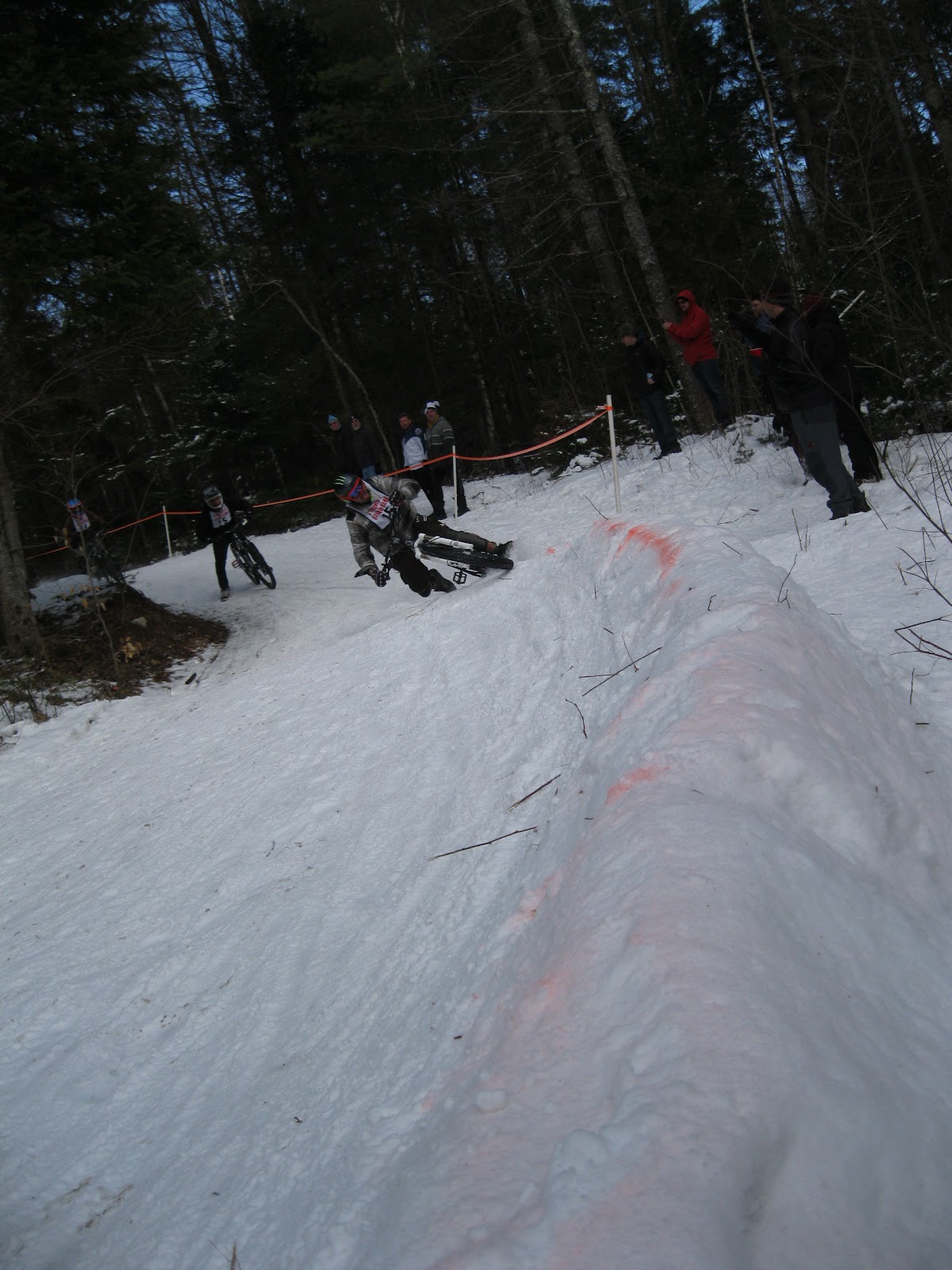
How not to approach a berm...


With predictable results.


Women's final.  


Brooke on the finishing stretch of the A final, way out front as he was on every other run.  

Ryan from MTBVT.com and the guys from Kingdom Trails put on a great event.  

Monday, March 5, 2012

Off Road Classics


This winter has been widely publicized for being rather mild, but there's still snow on the ground and I'm getting the jones to ride.  I guess it's not really a surprise that I happened upon these bikes on the retrobike.co.uk site and found them particularly captivating.

First up is a classic Yeti ARC.  The custom painted Rockshox Judy SL fork, matching ano turquoise
Ringle stem/post/bottle cage and deep section HED carbon wheels make this really look like every bit of the mid-90's racer it is.

This Yeti is a little more modernized and looks like it's ridden fairly regularly, unlike the previous bike listed in this post.  I'm not sure how they got disc tabs on the rear dropout without an ungainly adapter, but the paint-matched rigid fork and subtle but high end build kit means this bike gets ridden periodically and isn't just for show.


Any retro race bike post would be incomplete without a nod to the GT Zaskar.  Growing up GT was sold by a rival shop across town and so I'd developed a natural resistance to them.  It wasn't until college when I saw some up close (including Wayward's Xizang) and developed some respect and even a mild affinity for them.  Sometime during my college years GT fell on hard economic times, changed hands and then bumped their way along for a while.  Recently they've make a bit of a comeback and since sponsoring World Cup racers Todd Wells and Burry Stander have been making inroads back into the racing community again.  This particular model predates all that, and I think the Zaskar was one of the best mass produced race bikes of its time and truly represented GT in their hay day.  


This Merlin XLM is another throwback.  Many of Merlin's key employees survived the transfer of the original company and followed Rob Vandermark to Seven.  This was one of the Massachusetts-made ti frames that was undisputably one of the best options available in that material at the time.  There weren't many of these floating around back then, but given their durability (and the fact that mainly doctors and lawyers could afford them- there I said it) many of them are still in service.  I'm not sure how I feel about the "Afterburner" finish on the M960 XTR crank, but the rest of the bike looks pretty dialed with the cool for the 90's red ano parts treatment.  


Last is one of my favorites, the Fat City Shock a Billy.  I've mentioned these in previous posts, but I have say I think they're very cool.  I have no idea how well they ride or how durable they are, but the suspension concept was way ahead of what Trek and Cannondale were running at the same time with their unified rear triangle Super V's and Y-bikes.  Those things sucked.

SDG saddle, XTR 940 build kit and what looks like a Rock Shox Mag 21 painted to match.     


Ah bikes.  They're always fun to look at.  I can't wait to actually be able to ride again.  It won't be long.